
Cross-Chain Swaps, Multi-Chain Wallets, and the Security Problem Behind DeFi Convenience
The most dangerous moment in a cross-chain swap is often not the swap itself. It is the moment when a user stops asking what is happening because the interface makes the transaction look routine. A cross-chain trade can involve two networks, a bridge or messaging layer, several smart contracts, different fee assets, and an approval that remains active after the trade is finished. The visible action may be “swap,” but the underlying operation is closer to coordinating multiple independent systems. That distinction is the starting point for using DeFi safely.
For US users, this matters because a multi-chain wallet can make fragmented markets feel like one account. A single address may hold assets on Ethereum, Arbitrum, Base, Optimism, BNB Chain, Polygon, and other EVM-compatible networks, while each network has its own balances, transaction fees, applications, and failure modes. The convenience is real. So is the risk of mistaking a unified wallet interface for a unified security environment.
How cross-chain swaps actually work
A same-chain swap usually routes one asset into another through a decentralized exchange or an aggregator. The user signs a transaction, a contract executes a sequence of trades, and the result is settled on one network. A cross-chain swap adds a second settlement problem: the source chain and destination chain do not share a native transaction history or a common execution environment.
There are several ways to bridge that gap. A protocol may lock or escrow an asset on the source chain and release a corresponding representation on the destination chain. It may burn a token representation on one network and mint it on another. Alternatively, a liquidity provider may pay the user on the destination chain while the protocol later reconciles the provider’s position. These designs differ substantially in trust assumptions, liquidity requirements, speed, and recovery procedures.
That is why “cross-chain swap” is not a single technical category. It can describe a swap followed by a bridge, a bridge followed by a swap, or a coordinated route in which both actions are abstracted into one user flow. The interface may hide this sequencing, but the risks do not disappear. A failed swap can be different from a delayed message, a depleted destination liquidity pool, or an incorrect network selection.
One useful mental model is to treat a cross-chain route as a chain of conditional promises. The source transaction must be accepted. The bridge or messaging mechanism must observe it correctly. The destination-side action must execute under the expected conditions. Liquidity must be available where it is needed. Each promise may be fulfilled by a different contract, validator set, relayer, or liquidity provider. The route is only as reliable as its weakest dependency.
Fees also become less intuitive. A user may pay a source-chain gas fee, a protocol fee, a liquidity fee, a destination execution fee, and a network fee denominated in a token they do not currently hold. Slippage—the difference between the expected and executed price—can arise in more than one market. A quoted “low-cost” transaction may therefore be economical only under specific liquidity and congestion conditions.
Why a multi-chain wallet helps—and what it cannot solve
A multi-chain wallet reduces operational friction by allowing users to view and manage assets across networks without maintaining a separate browser profile or application for every chain. EVM compatibility also means that many networks use familiar address formats and signing standards. But identical-looking addresses do not mean identical assets, contracts, or transaction outcomes. Sending a token on the wrong network can be operationally similar to sending it to the wrong destination: the address may look correct while the funds remain inaccessible without specialized recovery steps.
A wallet is best understood as a signing and visibility layer, not as an insurance policy. It can help display the selected network, estimate balances, identify contract interactions, and present a transaction for approval. It cannot make a malicious contract safe, restore a private key that has been exposed, guarantee that a bridge will process a message, or reverse a confirmed blockchain transaction.
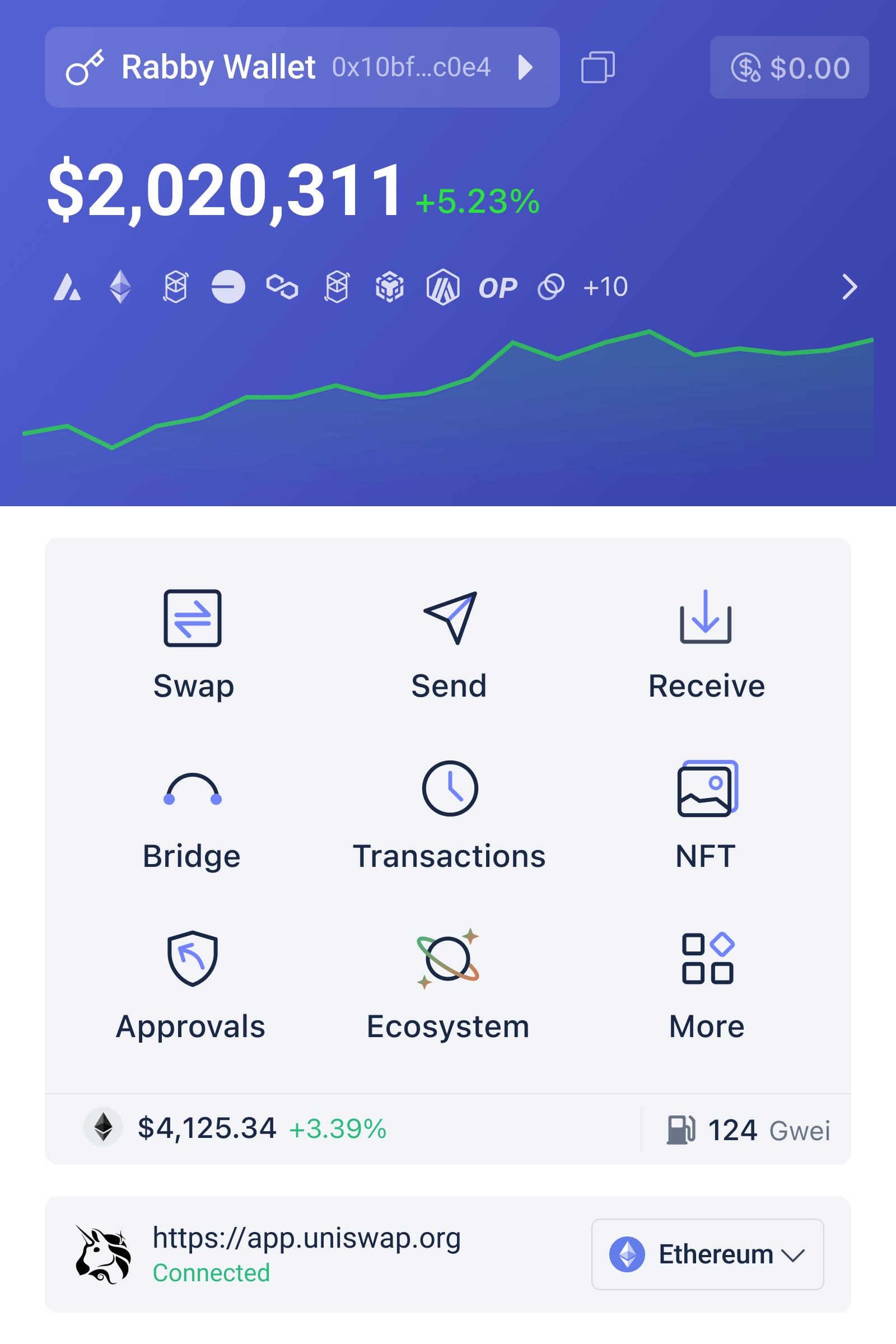
This boundary is particularly important when installing browser wallet software. Users should obtain wallet extensions through an official project channel, verify the publisher and domain, and avoid search advertisements or unsolicited links that imitate familiar branding. For readers evaluating installation instructions, the rabby extension should be treated as software that receives signing authority, not merely as a convenient browser add-on. The recovery phrase should never be entered into a website, support chat, or form presented during an installation process.
Rabby’s recent project messaging describes the wallet as a tool for Ethereum and EVM networks, emphasizing broad chain coverage and on-chain use across Chrome and Brave. That positioning is relevant to the current multi-chain environment, where users often move between ecosystems during a single research session. It should not be interpreted as evidence that every supported application or bridge has the same security quality. Wallet compatibility expands the surface that users can access; it does not standardize the behavior of the protocols they access.
DeFi security is a transaction-reading discipline
The most practical security improvement is to inspect what a transaction authorizes rather than relying on the label attached to a button. An approval may grant a contract permission to spend a token later. A permit-style signature may authorize spending without an immediately obvious on-chain approval transaction. A swap may call several contracts in sequence. A bridge may require one transaction on the source chain and another action on the destination chain. The more abstract the interface, the more valuable it is to understand the underlying permissions.
Before signing, a user should ask four questions. Which network is active? Which asset is leaving the wallet? Which contract or protocol is receiving authority? What exact asset and amount should return, and on which network? These questions sound basic, but they expose a common misconception: a wallet connection is not the same as a transfer. Connecting grants an application information about an address; signing a transaction or message can move assets or create future spending authority.
Transaction simulation can improve this review by showing expected balance changes and likely contract effects before confirmation. Yet simulation has limits. It reflects assumptions about current state and expected execution. A price can move, liquidity can change, a destination message can be delayed, or a contract can behave differently under conditions that the simulation does not capture. A favorable preview is evidence about a proposed action, not a guarantee about the final outcome.
Users should also separate three kinds of risk. Wallet risk concerns the theft or exposure of keys and signing authority. Protocol risk concerns bugs, flawed economic incentives, oracle failures, or bridge compromise. Market risk concerns price movement, slippage, liquidity loss, and depegging. A secure wallet can reduce some wallet risks while leaving protocol and market risks untouched. Conversely, a reputable protocol cannot protect funds if a user signs a malicious approval from a compromised device.
Historical evolution and the current trade-off
Early DeFi activity was largely concentrated on a small number of networks. As fees rose and alternative EVM chains matured, users gained cheaper execution and more specialized liquidity. Bridges then became essential infrastructure because assets and applications were distributed across these environments. The industry’s history shows a recurring trade-off: reducing friction tends to require more abstraction, while more abstraction can make it harder for users to see where trust and failure have moved.
Cross-chain systems have consequently developed different security models. Some rely on a relatively small group of validators or signers. Others use external messaging networks, proof systems, or liquidity arrangements. None should be judged only by speed or the number of supported chains. A slower system with clearer finality and recovery procedures may be preferable to a faster route whose failure state is difficult to understand. The right comparison depends on the value being moved, the user’s tolerance for delay, and whether the destination asset is liquid enough to exit.
There is also a subtle liquidity issue. A bridge can be technically operational while a particular route is economically poor. If destination liquidity is thin, the user may receive a worse price or face high slippage. Conversely, a route with deep liquidity may depend on assumptions about a wrapped asset maintaining its intended value. “Available on the destination chain” does not automatically mean “equivalent in risk or liquidity to the native asset.”
A practical framework for safer cross-chain use
For small experimental transactions, begin with a route whose components you can identify: source network, destination network, bridge or provider, swap venue, fees, and expected settlement time. Test with an amount that would be tolerable to lose. Confirm that you hold the native fee token on the relevant network, and record transaction hashes so that a delayed or incomplete route can be investigated without guessing.
For larger transfers, reduce complexity before increasing size. Avoid combining an unfamiliar bridge, a new token, a highly volatile market, and a large position in one transaction. Check whether the destination token is native, wrapped, or issued by an intermediary. Review approvals and revoke unnecessary permissions through a trusted method when they are no longer required, while recognizing that revocation itself is another transaction with a fee.
A reusable decision rule is to evaluate a route on five dimensions: asset identity, contract authority, bridge trust, liquidity, and recoverability. Asset identity asks whether the received token is the one intended. Contract authority asks what the wallet is permitting. Bridge trust asks who or what attests that the source-side event occurred. Liquidity asks whether the position can be traded or exited. Recoverability asks what support, proofs, or manual steps exist if the route stalls. A route that scores well on four dimensions can still be unacceptable if recoverability is effectively zero for the amount involved.
What to watch next
The next phase of multi-chain wallets is likely to be shaped less by the number of networks listed in a menu and more by how clearly the wallet communicates risk across them. If wallets can make contract permissions, asset provenance, route dependencies, and destination outcomes understandable without overwhelming users, they may reduce dangerous signing behavior. If abstraction simply hides more steps behind a single confirmation, convenience could increase faster than comprehension.
The key signal is not whether a wallet promises to make DeFi effortless. It is whether the interface helps the user recognize when a transaction is ordinary, when it is unusually complex, and when the proposed route depends on assumptions that deserve scrutiny. That is a more demanding standard, but it reflects how cross-chain systems actually work.
Frequently asked questions
Is a cross-chain swap safer than using a centralized exchange?
Neither category is automatically safer. A cross-chain swap preserves self-custody but exposes the user to smart-contract, bridge, liquidity, and key-management risks. A centralized exchange may simplify execution and recovery in some situations, but it introduces custody, account-access, platform, and regulatory risks. The meaningful comparison is between specific providers, controls, and amounts—not labels alone.
Why did my wallet show the right address but not the expected funds?
Addresses can be identical across EVM networks while balances remain network-specific. The funds may have arrived on a different chain, exist as a wrapped representation, or be held by a contract route that has not completed its destination step. Confirm the destination network and transaction status using a trusted block explorer, and do not sign additional “recovery” transactions supplied by unsolicited support contacts.
Does transaction simulation guarantee that a DeFi transaction is safe?
No. Simulation can reveal expected balance changes and suspicious permissions, but it cannot guarantee future market conditions, bridge execution, contract integrity, or the absence of a private-key compromise. Treat it as a useful inspection tool within a broader process of verifying the network, protocol, asset, approval, and route.